
GENESIS: Week 1
Genesis Before Genesis?
For many readers, Genesis 1–11 feels completely different to most of the rest of the bible.
The creation of worlds. A garden. A flood. A tower reaching into the heavens.
These stories often sit in our imagination as if they came out of nowhere, untouched by the cultures around them.
But when scholars began translating ancient Mesopotamian texts in the nineteenth century, something surprising happened: they discovered stories that sounded strangely familiar.
Stories about creation from chaos. Stories about humanity being formed from clay. Stories about a great flood sent to wipe out humanity.
Suddenly, Genesis looked less isolated and far more connected to the ancient world around it.
This section of Genesis is often called Primeval History - the story of the world before Abraham, before Israel, before kings and covenants. And one of the most fascinating things about it is that it seems to speak in conversation with older traditions from Mesopotamia.
Shared stories in a shared world
The ancient Near East was full of stories about origins. Civilisations asked the same questions we still ask now:
Why are we here?
Why do humans suffer and die?
Why are humans so violent?
Why do floods happen?
Why do we build cities and empires?
Genesis enters that conversation. But it doesn’t enter it in a vacuum.
Three texts are especially important when discussing Genesis 1–11:
Enuma Elish (c.1100-875BCE) - a Babylonian creation story
Atrahasis (c.1650BCE)- a Mesopotamian flood narrative
The Epic of Gilgamesh (c.1500BCE)- a Mesopotamian epic which also contains a flood story
The comparisons between these texts and Genesis are sometimes overstated, but they are also too significant to ignore.
Creation from chaos
Genesis 1 begins with darkness and deep waters:
“The earth was a formless void and darkness covered the face of the deep.” (Genesis 1:2)
That word “deep” — tehom in Hebrew — sounds remarkably similar to Tiamat, the chaotic sea goddess in Enuma Elish. Scholars debate whether the connection is linguistic, thematic, or both, but the parallels are difficult to miss.
In Enuma Elish, creation emerges through violent conflict. The god Marduk defeats Tiamat in battle and forms the world from her divided body.
There are some points of overlap, like the idea of division as a creative process.
But in ways, Genesis feels different immediately.
There is no divine warfare. No struggle. No rival gods. God simply speaks.
“Let there be…”
The biblical writers seem to take familiar ancient imagery, like watery chaos, ordered creation, the heavens and earth, but radically reshape it. Chaos is not another god. It is not a threat equal to God. It is simply material over which God rules completely.
This is one of the major patterns in Genesis 1–11. The text often appears to use shared cultural ideas while also contrasting with the worldviews behind them.
Humans made from clay
The similarities continue with humanity itself.
In Atrahasis, humans are created from clay mixed with the blood of a slain god. Their purpose is deeply functional: humans exist to do labour for the gods.
Genesis also speaks of humanity being formed from dust:
“The LORD God formed the human from the dust of the ground…” (Genesis 2:7)
Again, the comparison is striking. Humans formed from earth or clay was not unique to Israel.
But the differences matter just as much.
In Mesopotamian stories, humanity often exists because the gods are tired, annoyed, or in need of workers. Humans are effectively servants created to meet divine needs.
Genesis presents something far more dignified.
Humans are made “in the image of God.” They are given relationship, creativity, and responsibility. Work itself is not punishment or divine exploitation. It is part of human purpose.
The biblical text seems to stand inside the ancient conversation while simultaneously reframing it.
The flood story
The flood narrative is probably the clearest example of contact between Genesis and Mesopotamian traditions.
In Atrahasis and Gilgamesh, the gods decide to destroy humanity with a flood. One man is warned to build a boat. Animals are gathered. The flood comes. The boat rests on a mountain. Birds are sent out to test the waters. A sacrifice is offered afterwards.
Those are not vague similarities. They are highly specific narrative connections.
In Gilgamesh, Utnapishtim releases a dove, then a swallow, then a raven. In Genesis, Noah releases a raven and then doves.
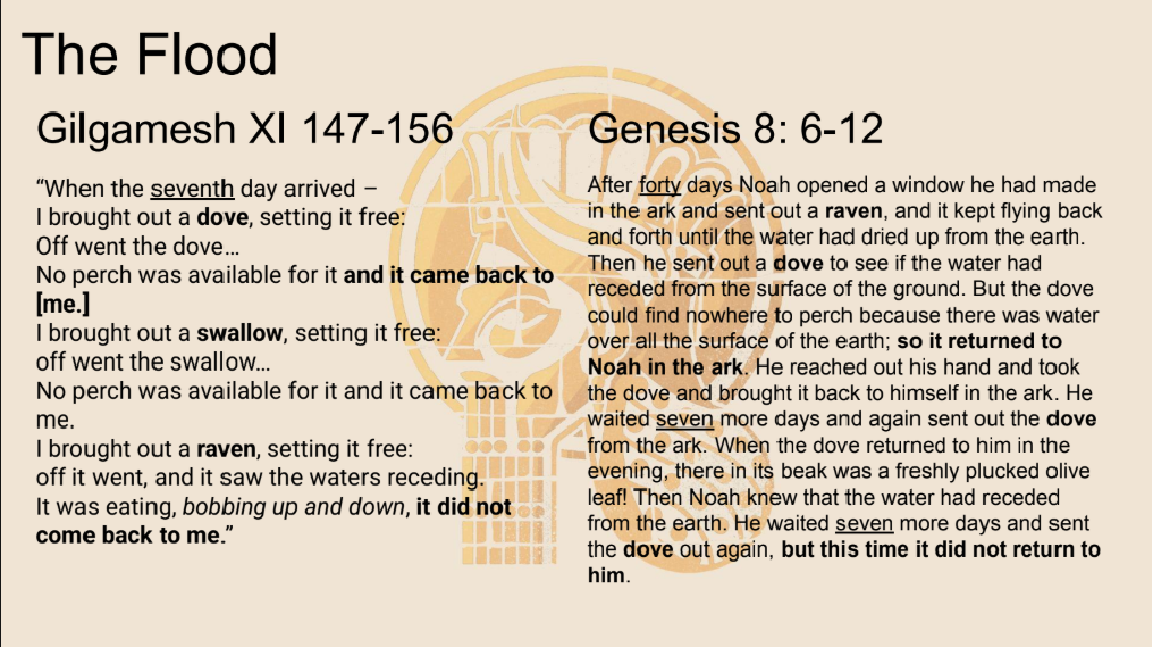
In both stories, the flood survivor offers a sacrifice after leaving the boat.
For many readers, these comparisons can feel unsettling. But most scholars today think some kind of literary relationship is highly likely.
The real question is not whether Genesis shares material with older traditions, but what Genesis is doing with them.
And again, the differences become theologically significant.
In Atrahasis, the gods send the flood because humans are too noisy. The gods themselves become frightened by the scale of destruction and later regret it because they miss the sacrifices humans provided.
Genesis presents a much more morally coherent picture. The flood is connected to violence and corruption:
“The earth was filled with violence.” (Genesis 6:11)
God doesn’t depend on human food or sacrifice to survive. The biblical account reframes the story around justice, human evil, grief, and covenant.
Borrowing, adapting, or something else?
So, did Genesis “copy” these stories?
That depends what we mean by copying.
Ancient writers did not think about originality in the same way modern people do. Stories were shared, reshaped, retold, adapted, and handed down across generations and cultures. Traditions travelled through trade, exile, migration, conquest, and oral storytelling.
Israel did not emerge in cultural isolation.
In fact, the Babylonian exile likely intensified Israel’s exposure to Mesopotamian literature and mythology. Some scholars argue that parts of Genesis reached their final form during or after this period, making these connections even more understandable.
But influence does not necessarily mean simple imitation.
The biblical writers appear to take familiar stories and redirect them toward different theological conclusions.
The Babylonian gods are violent, needy, and unpredictable.
Genesis presents one God who is sovereign, relational, and morally purposeful.
Mesopotamian humanity exists to serve divine convenience.
Genesis presents humans as image-bearers with dignity and responsibility.
Chaos is not divine. Empires are not ultimate. Violence is not normalised. Humanity matters.
In that sense, Genesis may be less like a detached alternative to Mesopotamian mythology and more like a response to it.
Why this matters
Some Christians worry that recognising these parallels somehow weakens Genesis. But for many scholars and theologians, the opposite is true.
The Bible was written by real people in real cultures speaking real languages into real historical moments.
Genesis does not emerge from nowhere. It emerges from the ancient world.
And perhaps that should not surprise us. Throughout scripture, God speaks through human cultures, human authors, human poetry, human history, and human understanding.
The remarkable thing is not that Genesis sounds ancient.
The remarkable thing is what it does with those ancient stories.
It takes the fears, myths, questions, and symbols of the ancient world and reshapes them around a radically different vision of God, humanity, and creation.
And thousands of years later, we are still arguing about it. But maybe that’s all just part of the fun…